

Few patients had ED lumbar CT or MRI within 30 days after low-acuity back-pain radiography at urgent care centers
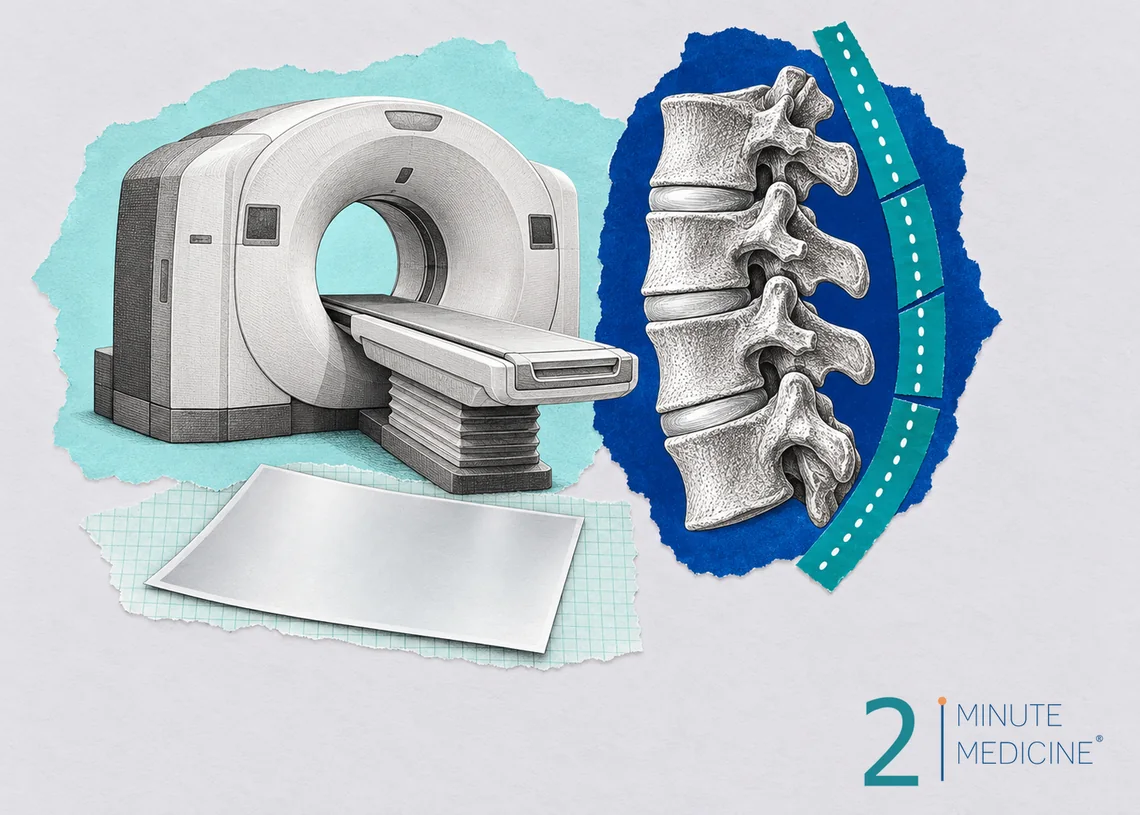
1. Few patients had ED lumbar CT or MRI within 30 days after low-acuity back-pain radiography at urgent care centers.
Evidence Rating Level: 3 (Average)
Study Rundown: Low back pain is a common cause of emergency department (ED) visits and accounts for the highest estimated health care costs along with neck pain. In the ED, lumbar imaging for nontraumatic back pain is discouraged per Choosing Wisely guidelines, but nearly a third of LBP ED patients are imaged. Hood and colleagues performed a retrospective, single-health-system observational comparison with 16,754 total imaging studies from 15,822 patients seen in urgent care centers (UCCs) and EDs to assess follow-up imaging in the ED across seven years. They found that 24 of 2,869 patients (0.82%, Wilson 95% CI 0.55–1.22%) who underwent lumbar radiography for LBP at UCCs had an ED visit with CT or MRI within 30 days. This trend was consistent across age groups and years included in the study. In addition, the researchers evaluated resource intensity of imaging studies by location through relative value units (RVUs), which were converted to estimated Medicare-allowed payments; these figures represent payments for the imaging studies, not total costs or cost-effectiveness. This showed an almost four-fold lower estimated imaging payment for radiographs at UCCs than for CT or MRI in EDs for LBP. Limitations of this study include the use of only one health system, patient and clinician preference differences, and lack of patient-reported outcomes. Because the source was unavailable, the full study population, site characteristics, statistical methods, adjustment for confounding, and whether the reported primary outcome and cost calculations match the publication could not be checked.
Click to read the study in the JACR (Journal of the American College of Radiology)
Click to read an additional editorial from the publishing laboratory
In-Depth [retrospective cohort study]: Hood and colleagues conducted a multi-site, retrospective cohort study within a single health system of adults 18 years of age and older who had lumbar spine imaging between January 1, 2019 and December 31, 2025. Sites included multiple EDs and 23 UCCs. Cohorts were divided into ED, which included CTs and MRIs of the lumbar spine, and UCC cohorts, which included lumbar or lumbosacral spine radiology. In total, 16,754 imaging studies were included; 2,924 were UCC lumbar radiographs and 13,830 were ED CT (n=12,983) or MRI (n=847). Any studies with red-flag presentations, including high-impact trauma, infection, malignancy, and neurologic compromise, were excluded. The UCC cohort included 2,869 patients and the ED cohort included 12,953 patients. The median interval between repeat imaging studies was 23 months (IQR 12-32) in the UCC cohort and 11 months (IQR 4-22) in the ED cohort; these intervals provide context for interpreting the 30-day follow-up outcome. Only patients who presented with low-acuity back pain were included. The index visit was the initial UCC visit for lumbar radiography, and a return visit was an ED visit for lumbar CT or MRI within 30 days of that index visit; 24 UCC patients had such a return visit. The primary outcome was the number of UCC radiology studies relative to the number of ED CT or MRI studies done in the next 30 days. In the UCC cohort, 24 of 2,869 patients (0.82%, Wilson 95% CI 0.55–1.22%) had ED CT or MRI in the next 30 days, with no additional repeat visits after the first for any patient. Median length of time was two days (IQR 0–6) for return visit to ED, while 50% (n=12) had their return visit within 24 hours. Secondary outcomes included 24-hour and seven-day return rates, length of time to first ED CT or MRI, and total RVUs translated into estimated Medicare-allowed payments In the UCC cohort, the median total RVU was 1.43 (IQR 1.40–1.44), which is approximately $48 Medicare-allowed payment per study. In the ED cohort, the median total RVU was 5.14 (IQR 5.05–6.50), which is approximately $171 Medicare-allowed payment per study. Overall, this study found lower estimated imaging payment for UCC radiographs than for ED CT or MRI among patients with low-acuity back pain; because this was a retrospective observational comparison, the UCC and ED groups may have differed in patient characteristics, clinical indications, and clinician or patient selection.
© 2026 2 Minute Medicine, Inc. All rights reserved. No part of this article may be reproduced, distributed or transmitted in any form or by any means without the prior written permission of 2 Minute Medicine, Inc. To license this content, contact 2 Minute Medicine, Inc. This article is for informational and educational purposes only; it is not medical advice and does not replace the judgment of a qualified healthcare professional.
Image: © 2 Minute Medicine
RelatedReports








 Get the app